


For years, MSPs have been told they must evolve in order to win and retain customers. A recent report from Corsica Technologies confirms this pressure is intensifying, specifically among midmarket organizations.
In Corsica’s report, 65 percent of midmarket companies said they are considering switching MSPs in the next 12 months — suggesting loyalty is getting harder to maintain.
“Respondents are silently shopping, and open to new providers in a way that they haven’t been in the past,” CEO Brian Harmison explained to ChannelVision. “And it’s especially interesting when considering a very high percentage feel like their MSP is trustworthy.”
Most respondents in Corsica’s report (87 percent) said they are currently satisfied with the strategic guidance they receive from their MSPs, while most agreed that their provider has made managing technology easier. And almost 96 percent said they trust their MSP at least somewhat to act in their organization’s best interest.
Corsica’s findings reflect a broader shift in technology buying. For example, the latest research from Telarus found that 84 percent of IT buyers are open to switching vendors at renewal, driven by factors such as rising renewal costs, buyer’s remorse and unmet expectations.
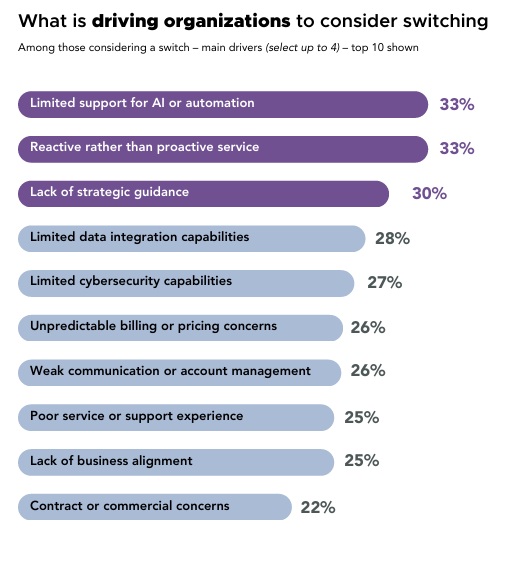
For MSPs, however, customer loyalty appears to be more nuanced. As Corsica explained in its report, respondents are no longer just analyzing whether their MSP has performed adequately. They are also considering whether their providers can help them navigate future needs around AI adoption, cybersecurity, data complexity and automation.
Thirty-three percent of those considering a switch pointed to limited support for AI and automation as a leading driver.
“Our research points to a shift in what matters in the MSP space,” Harmison said. “Up until recently, we focused heavily on the blocking and tackling of IT support and cybersecurity. Now, customers are looking ahead and asking where AI is going and how data fits into the picture.”
Despite the high percentage of companies that are considering switching MSPs, Harmison doesn’t anticipate a massive churn event within the next year. In fact, Harmison expressed excitement about the changing landscape and the opportunity it presents for MSPs that can rise to the challenge.
“I view this more as a wake-up call for MSPs to stop talking about SLAs, tickets and cyber events and start talking about actual business challenges,” Harmison said. “This requires a change in conversation from the things that have really mattered in the past. As an MSP, if you’re still having monthly meetings only talking about operational issues, then you’re likely going to put yourself on a path where your customers go find a more business- and technology-focused MSP.”
According to Harmison, this requires taking the time to understand each customer and focus conversations on business outcomes — especially as technology spending decisions are increasingly driven by boards and executive teams.
“We’re really focusing on those strategic conversations,” Harmison explained. “Where is your business going? How do you plan to leverage AI? We’re not asking if they’re planning to use it. We’re going in saying, industries like yours are being revolutionized by AI in these areas. How can we start to prepare you to be competitive and be in that seat alongside you to help you advance those initiatives?”